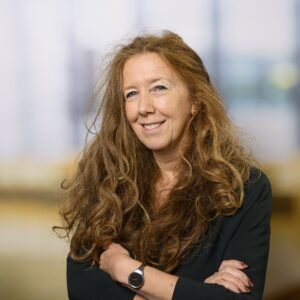
Long before Alexandra became a professor of Public Real Estate in 2018, her fascination with campuses began in the most natural way possible: simply by being a student. Walking through lecture halls, study rooms, and courtyards with a growing sense of curiosity not just about what happened inside them, but about the spaces themselves. Why were some buildings always buzzing with life while others stayed strangely quiet? How did a campus breathe, respond, or transform as the academic year unfolded? Those early observations eventually became the foundation of a lifelong passion.
Her fascination further developed into a research path that now spans decades. The campus became both her home base and her academic subject. Which gives Alexandra a unique dual perspective. Over the years, she examined campuses not only as physical environments but as living labs and ecosystems shaped by human behavior, policies, financial decisions, technological demands, and environmental challenges. It is this rich mixture of practice, theory, and personal connection that forms the heart of her newly published book Campus of the future: Managing a matter of Solid, Liquid and Gas. The book began as her inaugural address as professor of Public Real Estate and evolved into a broader vision, based on her prior publications and research of TU Delft’s Campus Research Team. The work reflects her academic journey at a university of technology, and her insights from 25 years of campus observations.
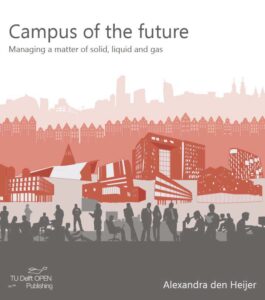
The timing of the first version of the book was also a moment to remember. Just as she prepared to publish it in 2020, campuses around the world unexpectedly emptied. Overnight physical became virtual. Students and staff rediscovered the importance of in-person environments by suddenly losing them. This could not be left unexplored, so she decided to postpone the initial publication and include the impact of COVID on the campus. As she interviewed campus managers across Dutch universities during the pandemic years, her research gained depth without changing its message. Campuses matter, not only as places of education, but as organisational, cultural, and social anchors.
When she decided to publish officially with TU Delft OPEN Publishing, the university press of TU Delft, it was a deliberate choice. She wanted the book to move beyond her immediate academic circle and reach the broader community of stakeholders involved in public real estate and campus development. TU Delft OPEN Publishing offered transparency, accessibility, open license, and the support she needed to mainstream the publication process including peer reviews and ensure the book became truly public.
Today, her work stands as both reflection and roadmap. It is rooted in her journey from curious student to leading academic and shaped by a belief that the future of campuses requires all of us to think, design, and decide consciously. While she focuses on universities and campuses, the future models and themes in this book also apply to many other (public) organisations and their built environments.